
Table of Contents
- What Is the Number 27?
- Is 27 a Prime Number?
- 27 in Roman Numerals
- How to Write 27 in Words
- Mathematical Properties of 27
- Special Characteristics and Patterns
- Conclusion
- Frequently Asked Questions
Last Updated: October 17, 2026
What Is the Number 27?
The number 27 is a composite integer that sits between 26 and 28 on the number line. It represents a quantity of three groups of nine, or equivalently, three cubed (3³). Understanding what 27 is forms the foundation for exploring its mathematical properties and significance across different contexts.
In everyday life, the number 27 appears more often than you might realize. It shows up in measurements, time calculations, and practical applications. For those working with mental health data or clinical metrics in Pearland and surrounding areas, understanding numerical properties like those of 27 can support pattern recognition and data interpretation in treatment tracking.
The number 27 holds particular interest in mathematics because of its unique structure. It is neither prime nor a simple power of two, which makes it worthy of deeper examination. This composite nature gives 27 several distinguishing characteristics that set it apart from other numbers in its range.
The number 27 is a composite integer equal to 3³, representing three multiplied by itself three times. Its structure and properties make it mathematically significant beyond simple counting.
Is 27 a Prime Number?
No, 27 is not a prime number. A prime number is defined as a natural number greater than one that has no positive divisors other than one and itself (NICE eNewsletter Spring 2022 Academic Spotlight | NIST). The number 27 fails this test because it can be divided evenly by several numbers beyond just one and 27.
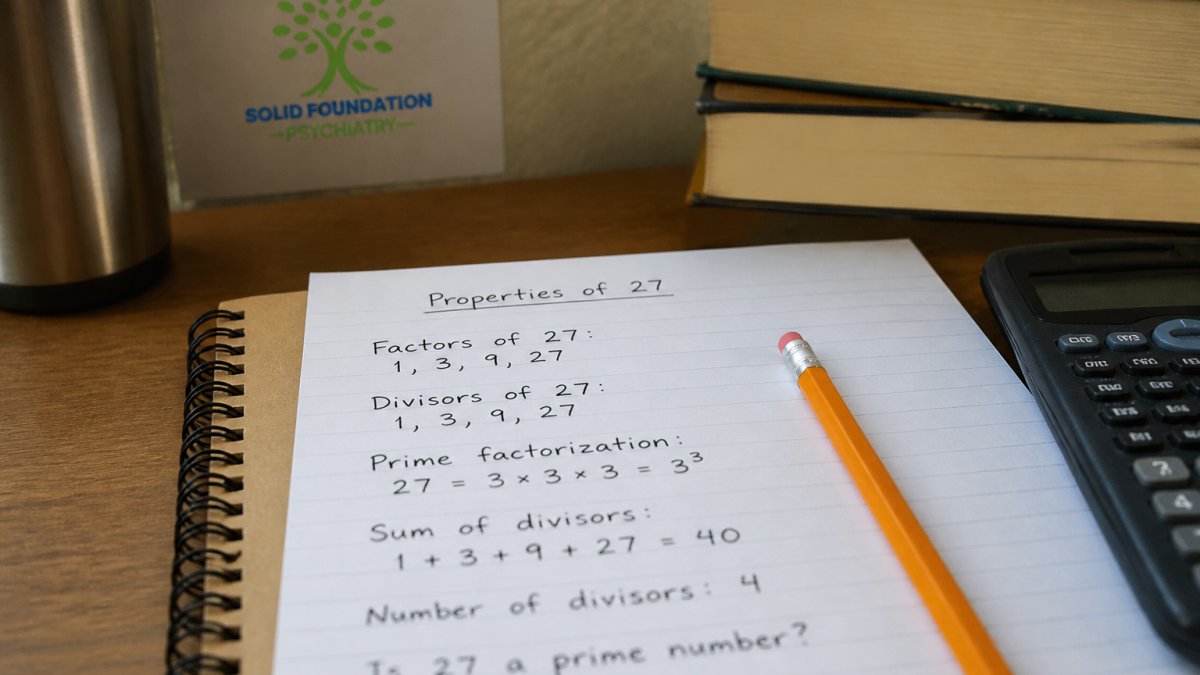
The divisors of 27 are: 1, 3, 9, and 27. Since 27 can be divided by 3 and 9 without leaving a remainder, it qualifies as composite rather than prime. This makes 27 a perfect example of what distinguishes composite numbers from primes in the mathematical landscape.
Breaking down 27 into its prime factors reveals the core of its structure. When you factor 27 completely, you get 3 × 3 × 3, or 3³. This prime factorization shows that 27 is composed entirely of the prime number 3 repeated three times. Understanding whether 27 is a prime number requires recognizing this composite structure, which has practical applications in fields ranging from cryptography to data organization.
To quickly check if 27 is prime, test divisibility by small primes like 2, 3, and 5. Since 27 divides evenly by 3 (27 ÷ 3 = 9), you immediately know it’s composite. This shortcut works for any suspected composite number.
27 in Roman Numerals
The number 27 in Roman numerals is written as XXVII. This representation combines the Roman numeral symbols according to specific rules that have governed mathematical notation for centuries.
Breaking down XXVII: the first X represents 10, the second X represents another 10, the V represents 5, and the two I symbols each represent 1. When added together, 10 + 10 + 5 + 1 + 1, they equal 27. Roman numeral notation follows an additive principle where symbols are placed in descending order of value from left to right.
The Roman numeral system differs fundamentally from our modern decimal system. While we use positional notation with a base of 10, Roman numerals rely on specific symbols and their combinations. For the number 27, there is no subtractive notation involved (unlike 4, which is written as IV rather than IIII). This straightforward additive approach makes XXVII one of the clearer Roman numeral expressions.
Understanding how 27 appears in Roman numerals connects to historical contexts and formal applications. Legal documents, clock faces, and formal inscriptions still use Roman numerals, making this knowledge relevant for reading and interpreting historical or ceremonial materials.
How to Write 27 in Words
The number 27 is written in words as “twenty-seven.” This English word representation uses the compound form that combines the tens place with the ones place, following standard English naming conventions for numbers between twenty and ninety-nine.
When writing 27 in words, no hyphens are used in modern American English, though some style guides may vary. The straightforward spelling “twenty-seven” appears in formal documents, written communication, and any context where numbers are expressed as words rather than numerals.
In different contexts, the written form of 27 serves distinct purposes. Legal documents often require numbers to be written out in full. Checks, formal letters, and official records all use “twenty-seven” to avoid ambiguity. This written representation ensures clarity and prevents misinterpretation, which is especially important in healthcare and clinical settings where precision matters. At Solid Foundation Psychiatry in Pearland, accurate documentation, including proper number representation, supports clear communication regarding treatment plans and progress tracking.
When writing 27 in formal documents, always spell it as “twenty-seven” rather than mixing numerals and words. Inconsistent notation can create confusion in medical records, legal paperwork, and financial documents where accuracy is critical.
Mathematical Properties of 27
The number 27 exhibits several fascinating mathematical properties that make it distinctive within the integer system. Its most fundamental property is that it equals 3³, making it a perfect cube. This means 27 is the product of three multiplied by itself three times: 3 × 3 × 3 = 27.
As a perfect cube, 27 belongs to a special category of numbers. Perfect cubes are relatively rare compared to other integers, and they appear frequently in geometry, volume calculations, and three-dimensional mathematics. The cube root of 27 is exactly 3, which makes this number geometrically significant, a cube with sides of length 3 units has a volume of exactly 27 cubic units.
The divisors of 27 are limited to 1, 3, 9, and 27. This divisor set reveals the number’s structure. The sum of divisors (excluding 27 itself) is 1 + 3 + 9 = 13, making 27 a deficient number in number theory terminology. Additionally, 27 is an odd number, which means it cannot be divided evenly by 2.
In modular arithmetic, 27 has interesting properties. It is congruent to 0 modulo 9, meaning 27 is divisible by 9. The digital root of 27 (found by repeatedly summing digits: 2 + 7 = 9) is 9, which connects to its divisibility by 9. These properties make 27 useful in various mathematical applications and verification techniques.
Special Characteristics and Patterns
The number 27 appears in numerous mathematical sequences and patterns that extend beyond its basic properties. In the Fibonacci sequence, 27 does not appear directly, but it holds significance in other sequences and mathematical structures. The number 27 is a Harshad number, meaning it is divisible by the sum of its digits (2 + 7 = 9, and 27 ÷ 9 = 3).
Cultural and symbolic significance surrounds 27 in various contexts. Some traditions assign numerological meaning to 27, viewing it as a number associated with completion and cycles. In music, the equal temperament tuning system divides the octave into 12 semitones, and 27 semitones represent a frequency ratio that musicians recognize. Scientific contexts also reference 27, for example, the periodic table shows that cobalt has 27 protons in its nucleus.
The number 27 appears in time measurements as well. Twenty-seven days approximates the lunar cycle, which has influenced human timekeeping and cultural practices for millennia. In astronomy, certain orbital periods and celestial mechanics involve 27-day cycles. These real-world appearances demonstrate that 27 is not merely an abstract mathematical concept but a number embedded in natural phenomena and human systems.
When working with data in healthcare settings like those in Pearland, recognizing numerical patterns, including the properties of specific numbers like 27, supports analytical thinking. Understanding the mathematical foundation of numbers enhances precision in clinical documentation and data interpretation.
Conclusion
The number 27 is a composite integer with remarkable mathematical properties that extend far beyond simple arithmetic. It is not a prime number, can be expressed as 3³ in Roman numerals as XXVII, and in English words as “twenty-seven.” Its status as a perfect cube makes it geometrically significant, while its divisor set and digital properties reveal deeper mathematical structure.
Understanding numbers like 27 supports clearer thinking about mathematical relationships and patterns. Whether you encounter 27 in academic contexts, professional applications, or everyday situations, recognizing its properties enriches your mathematical literacy. If you’re seeking compassionate, personalized psychiatric support, Book Appointment with our experienced team to discuss how we can support your mental health journey with evidence-based treatment tailored to your unique needs.
According to the National Institute of Mental Health, precision in clinical documentation directly supports better patient outcomes and treatment coordination. At Solid Foundation Psychiatry, we maintain meticulous records and clear communication to ensure your care is coordinated and responsive to your needs. Whether you’re managing depression, anxiety, PTSD, or other mental health conditions in the Pearland area, our collaborative approach to personalized treatment planning ensures you receive the expert care you deserve. Our team offers individual therapy, medication management, and specialized treatments including TMS and Esketamine therapy, all designed to help you build resilience and restore emotional balance. Reach out today to learn how our evidence-based, compassionate approach can support your path toward lasting well-being.
Frequently Asked Questions
Is 27 a prime number?
No, 27 is not a prime number. It is a composite number because it has factors other than 1 and itself. Specifically, 27 can be divided evenly by 1, 3, 9, and 27. In fact, 27 equals 3 × 3 × 3, making it a perfect cube of the number 3.
What is 27 in Roman numerals?
In Roman numerals, 27 is written as XXVII. The X represents 10, the V represents 5, and the I represents 1. So XXVII breaks down as 10 + 10 + 5 + 1 + 1, which totals 27. Roman numeral notation was used in ancient Rome and remains common in formal or historical contexts today.
How do you write 27 in words?
The number 27 is written in words as twenty-seven. This is the standard English spelling used in formal writing, checks, and documents.