Table of Contents
- Understanding Treatment-Resistant Depression and Your Options
- Personalized Psychiatry vs. Standard Care: Why Individual Treatment Plans Matter
- TMS Therapy for Depression in Pearland: How It Works and What to Expect
- Esketamine (Spravato) and IV Ketamine: Rapid-Acting Treatment Pathways
- How to Find a Psychiatrist for Treatment-Resistant Depression
- What to Look for in a Mental Health Provider
- Making Your Decision: Questions to Ask Before Starting Treatment
- Frequently Asked Questions
Last Updated: August 17, 2026
Understanding Treatment-Resistant Depression and Your Options
Treatment-resistant depression affects people who haven’t found relief after trying two or more antidepressants. If you’re in Pearland or the surrounding areas and standard medications haven’t worked, you have more options than you might think. Finding the right treatment-resistant depression alternatives requires understanding what’s available beyond conventional therapy and medication management.
At Solid Foundation Psychiatry, we recognize that one-size-fits-all approaches often fail for people with complex depression. Specialized treatments have emerged over the past decade, offering pathways that work differently than traditional antidepressants, from brain stimulation therapies to rapid-acting medications that target different neurological pathways.
This guide walks you through the most effective alternatives available in Pearland and the Houston area, what each approach involves, and how to decide which might work best for your situation. We’ll cover personalized psychiatry, TMS therapy, esketamine (Spravato), IV ketamine, and what to look for when choosing a mental health provider.
Treatment-resistant depression isn’t a dead end, it’s a signal that you need a different approach. Multiple evidence-based alternatives exist beyond standard medication.
Personalized Psychiatry vs. Standard Care: Why Individual Treatment Plans Matter
Personalized psychiatry tailors mental health treatment to your unique biology, circumstances, and response patterns rather than following a standardized protocol. Unlike standard care, which relies on a predetermined sequence of medications, personalized psychiatry considers your genetics, previous medication responses, lifestyle factors, and specific symptoms to build a custom treatment plan.

This approach matters most for treatment-resistant depression. Standard care typically follows a linear sequence: try SSRI A, then SSRI B, then switch to a different class, a process that can take months or years. Personalized psychiatry accelerates this by using clinical judgment, sometimes genetic testing, and detailed history-taking to identify which treatments are most likely to work for you specifically.
Personalized approaches change the dynamic by ensuring your provider understands not just your symptoms but your work stress, sleep patterns, trauma history, family medical background, and how previous medications actually affected you. This means fewer wasted months on unlikely treatments and faster movement toward options that address your actual neurochemistry.
Solid Foundation Psychiatry emphasizes this collaborative, individualized approach. Rather than following a checklist, the team develops treatment plans reflecting your specific needs and circumstances.
Ask potential providers: “How do you decide which medication or treatment to try first?” If the answer is “we follow a standard protocol,” that’s standard care. If they ask about your specific history, previous responses, and lifestyle factors, that’s personalized psychiatry.
TMS Therapy for Depression in Pearland: How It Works and What to Expect
Transcranial magnetic stimulation (TMS) is a non-invasive brain stimulation treatment using magnetic pulses to activate neurons in areas associated with mood regulation. The FDA cleared TMS specifically for treatment-resistant depression, making it one of the most established alternatives when medications haven’t worked.
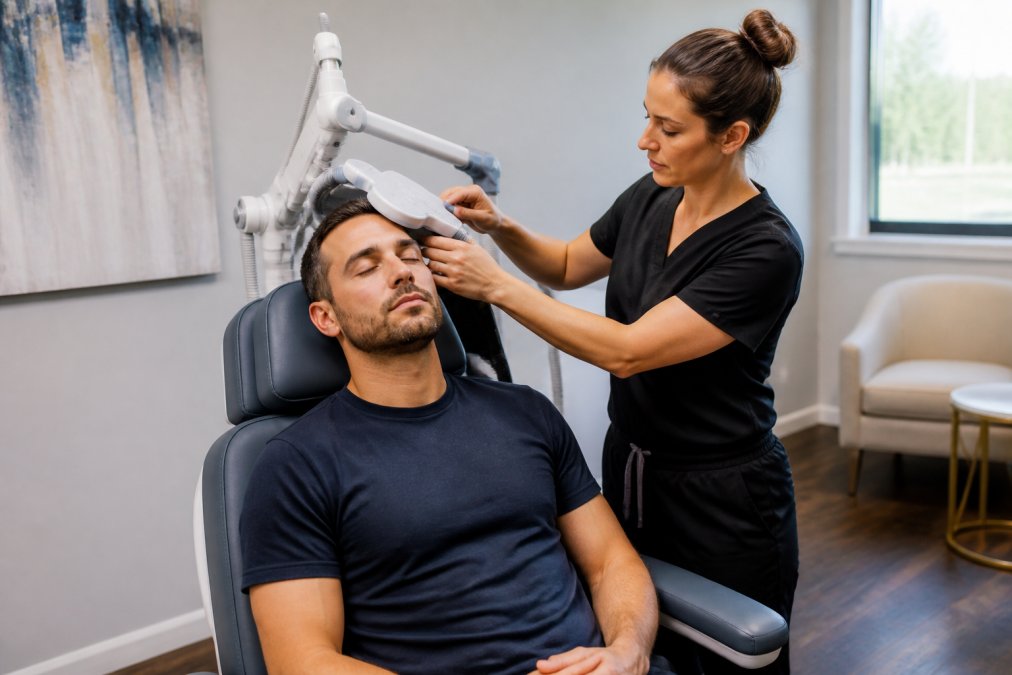
During a typical TMS session, you sit in a reclined chair while a trained technician positions a magnetic coil against your scalp. The coil delivers rapid magnetic pulses that create electrical currents in your brain. Sessions last 30-40 minutes, and you remain awake throughout. Most people describe the sensation as a tapping or knocking feeling rather than pain. You can return to normal activities immediately after, no sedation or recovery time needed.
A full course typically requires 30-36 sessions spread over 4-6 weeks, meaning visits several times per week. For professionals in the Houston area with demanding schedules, this requires flexibility, though some providers offer early morning or evening slots.
TMS works by stimulating the dorsolateral prefrontal cortex, a brain region involved in mood and motivation. This stimulation helps restore normal mood regulation in people whose depression hasn’t responded to medication. Many patients report gradual improvement over the course of treatment, with benefits often continuing afterward.
Solid Foundation Psychiatry offers TMS therapy as part of a comprehensive treatment approach, coordinating it with medication management and therapy to maximize results.
TMS requires significant time commitment. If you cannot attend sessions 3-5 times per week for 4-6 weeks, discuss alternative options with your provider.
Esketamine (Spravato) and IV Ketamine: Rapid-Acting Treatment Pathways
Esketamine (Spravato) and IV ketamine represent a fundamentally different approach to treatment-resistant depression. Instead of waiting weeks for medication to build up in your system, these treatments can produce measurable improvement within hours or days by affecting the glutamate system in your brain, a pathway that traditional antidepressants don’t target.
Esketamine (Spravato) is an FDA-approved nasal spray specifically designed for treatment-resistant depression and depression with suicidal thoughts. You administer it in a clinical setting under direct medical supervision. A typical induction phase involves twice-weekly sessions for 4 weeks, then weekly sessions for another 4 weeks, with a 2-hour monitoring period afterward. You cannot drive or operate machinery during this time.
Esketamine produces a dissociative effect, a temporary sense of detachment or altered perception, that typically resolves within an hour. Many people describe it as unusual but not frightening, especially when they know what to expect. The rapid symptom relief is the trade-off for this temporary experience.
IV ketamine therapy works similarly but is administered as an intravenous infusion. A typical protocol involves 6 infusions over 2-3 weeks, with each session lasting 40-60 minutes. IV ketamine is often used off-label for depression, though evidence supporting its use is substantial.
The speed of these treatments matters most for people in crisis. If you’re experiencing severe depression with suicidal thoughts, waiting weeks for traditional treatments isn’t acceptable. Esketamine and IV ketamine can provide relief when you need it most.
Esketamine and IV ketamine work best for people who need rapid relief, have severe depression with suicidal ideation, or have failed multiple traditional antidepressants.
How to Find a Psychiatrist for Treatment-Resistant Depression
Finding the right psychiatrist requires more than checking insurance panels. You’re looking for someone with specific expertise in treatment-resistant depression, adequate availability, and a treatment philosophy matching your needs.
Ask whether potential providers have experience treating treatment-resistant depression specifically. This differs from general depression treatment. Psychiatrists who regularly work with this population know which treatment combinations work and when to recommend specialized options like TMS or esketamine.
Location and availability matter practically. If you’re in Pearland and a provider is downtown Houston, commuting for frequent appointments becomes a barrier. Solid Foundation Psychiatry, located in Pearland, serves the local area.
Insurance coverage varies widely. Before scheduling a consultation, call your insurance company and ask specifically about coverage for treatments you’re considering. TMS, esketamine, and IV ketamine have different coverage policies even within the same plan.
Ask about the provider’s approach to medication management. Do they actively monitor and adjust, or prescribe and see you monthly? Do they order genetic testing to identify which medications are most likely to work for your biology? Proactive medication management accelerates progress.
Call 3-5 psychiatrists before committing. Ask the same questions to each to recognize which providers take time to understand your situation.
What to Look for in a Mental Health Provider
Beyond credentials and location, certain qualities distinguish providers who excel at treating treatment-resistant depression.
Listen for genuine curiosity about your history. A good provider asks detailed questions about which medications you’ve tried, how they made you feel, and what worked partially. They want the full story, not just “I tried Zoloft and it didn’t work.”
Assess whether they explain the “why” behind recommendations. When suggesting TMS or esketamine, they should explain how it works, what to expect, realistic timelines for improvement, and potential limitations. If recommendations feel rushed or unclear, that’s a red flag.
Look for providers who integrate multiple treatment modalities. The best outcomes typically come from combining approaches: medication management, therapy, sometimes specialized treatments like TMS, and lifestyle modifications.
Check whether they coordinate with other providers. If you’re seeing a therapist separately, does your psychiatrist communicate with them? Solid Foundation Psychiatry emphasizes coordinated care, ensuring all providers work toward the same goals.
Ask about their approach to side effects and medication adjustments. How does your provider balance efficacy against tolerability?
Avoid providers who dismiss your concerns about side effects or seem frustrated by treatment-resistant depression.
Making Your Decision: Questions to Ask Before Starting Treatment
Choosing between alternatives requires understanding your priorities, constraints, and what realistic improvement looks like.
Start with a clear assessment of your current situation. How long have you been struggling? How many medications have you tried? Are you having thoughts of suicide? Do you have the time and transportation for frequent appointments? This baseline shapes which treatments make sense.
Ask each provider: “What would success look like in my case, and how long would it take?” Be skeptical of quick-fix promises, but recognize that treatment-resistant depression sometimes responds dramatically to the right intervention.
Understand the commitment required. TMS demands 4-6 weeks of frequent appointments. Esketamine requires 8+ weeks of twice-weekly sessions initially. IV ketamine typically involves 6 infusions over 2-3 weeks. If you cannot commit to the schedule, the treatment won’t work.
Discuss costs and insurance coverage explicitly. Many specialized treatments have manufacturer assistance programs that can reduce costs significantly. Solid Foundation Psychiatry can help verify insurance coverage and discuss realistic costs before you begin.
Consider whether you want to try medications or specialized treatments first. Some prefer exhausting medication options before TMS or esketamine. Others, especially those with severe depression or suicidal thoughts, want rapid-acting options immediately.
Ask about follow-up and maintenance. What happens after you complete a course of TMS or esketamine? Do you continue medication? How often will you see your provider? Long-term success requires ongoing support.
A comparison of key considerations follows:
| Treatment | Time Commitment | Speed of Relief | Insurance Coverage | Best For |
|---|---|---|---|---|
| Personalized medication management | Monthly appointments | 4-8 weeks | Usually covered | Starting point for most people |
| TMS therapy | 30-36 sessions over 4-6 weeks | Gradual over weeks | Often covered with prior auth | People who prefer non-medication options |
| Esketamine (Spravato) | 8+ sessions over 8 weeks | Hours to days | Often covered; check plan | Severe depression; need rapid relief |
| IV ketamine | 6 infusions over 2-3 weeks | Hours to days | Usually not covered; out-of-pocket | Severe depression; need rapid relief |
Finding the right treatment-resistant depression alternatives means matching your needs to the right provider and treatment approach. Solid Foundation Psychiatry specializes in helping people in Pearland and the surrounding areas navigate complex depression with personalized, evidence-based care. The team offers medication management, therapy, and TMS. If you’ve tried standard treatments without success, evidence supports specialized approaches for treatment-resistant depression and you deserve access to them. Book an appointment with Solid Foundation Psychiatry and take the first step toward a treatment plan designed specifically for you.
Frequently Asked Questions
What is considered treatment-resistant depression?
Treatment-resistant depression occurs when a person does not respond adequately to at least two different antidepressant medications at therapeutic doses. This affects about 30% of people with depression. If you’ve tried multiple medications without meaningful improvement, specialized treatments like TMS or Esketamine may be appropriate. A qualified psychiatrist can evaluate whether your depression meets this criteria and recommend alternatives suited to your situation.
How does personalized psychiatry differ from standard mental health care?
Personalized psychiatry tailors treatment plans to your unique symptoms, medical history, lifestyle, and goals rather than applying a one-size-fits-all approach. Providers using this model conduct thorough assessments, involve you in treatment decisions, and adjust care based on your response. Standard care may rely more heavily on protocol-driven treatment. Personalized approaches often lead to better outcomes because they address your specific needs and build collaborative relationships that support long-term recovery.
Are there specialized depression treatments available in Pearland, TX?
Yes. Pearland and the surrounding Houston area offer several advanced treatments for treatment-resistant depression, including TMS therapy, Esketamine (Spravato), and IV ketamine infusions. These are FDA-approved or FDA-cleared options that work through different mechanisms than traditional antidepressants. Many are covered by insurance for treatment-resistant depression. Consulting with a local psychiatrist can help you explore which option aligns with your needs and circumstances.
What role do TMS and Esketamine play in treating depression?
TMS (Transcranial Magnetic Stimulation) uses magnetic pulses to stimulate brain regions involved in mood regulation. It’s non-invasive, requires no anesthesia, and typically involves 30-36 sessions over 4-6 weeks. Esketamine (Spravato) is a nasal spray that affects the brain’s glutamate system and often produces faster relief, sometimes within hours or days. Both are FDA-approved for treatment-resistant depression and may be combined with therapy and medication management for optimal results.
How do I choose the right mental health provider or clinic for treatment-resistant depression?
Look for providers who offer personalized, collaborative care and specialize in treatment-resistant depression. Verify they are licensed psychiatrists or psychiatric nurse practitioners with experience in advanced treatments like TMS or Esketamine. Check whether they coordinate care between therapists and prescribers, offer flexible scheduling, and accept your insurance. Ask about their approach to treatment planning and whether they involve you in decisions. Reading patient testimonials and scheduling a consultation can help you assess whether the clinic’s values and style match your needs.
This article was written using GrandRanker