
Last Updated: November 10, 2026
Quick Summary
52 factorial, written 52!, is the product of every whole number from 52 down to 1, and it counts the number of possible orders a standard 52-card deck can take. Its value is about 8.0658175 × 10^67, a number with 68 digits. Each distinct ordering of the deck is one permutation, and a perfectly random shuffle makes all of them equally likely.
- 52 factorial equals 52 × 51 × 50 × … × 3 × 2 × 1.
- Its value is approximately 8.0658175 × 10^67, a 68-digit number.
- It counts the distinct permutations of a standard 52-card deck.
- A perfect random shuffle makes each ordering equally likely.
- Exact results need arbitrary-precision tools, since standard calculators round.
Table of Contents
- What 52 Factorial Explained Actually Means
- How Many Ways to Shuffle a Deck of Cards
- Calculating 52 Factorial Step by Step
- 52 Factorial Seconds: How Long Would Counting Take?
- Visualizing the Scale of 52 Factorial
- Probability of One Particular Shuffled Order
- Using the Number Confidently in Your Own Work
- Frequently Asked Questions
What 52 Factorial Explained Actually Means
This explainer on 52 factorial is written for curious readers who want to understand one of the most striking numbers in ordinary life. A factorial is the product of every whole number from 1 up to a given value, so 52 factorial (written 52!) means multiplying 52 × 51 × 50 × … × 3 × 2 × 1. The result is a number so large that it changes how we think about chance.
52 factorial is a mathematical quantity, and this article stays within mathematics. The number matters because it answers a concrete question: how many distinct orders can a standard deck of cards take? Mathematicians call each distinct ordering a permutation, and the count of permutations of 52 distinct cards is exactly 52!. For a deeper look at how a figure like this breaks down into its meaning and factors, see another number-explainer page.
How Many Ways to Shuffle a Deck of Cards
A standard deck has 52 cards, each one different from the others. Shuffling rearranges them, and each possible arrangement is one way the deck can end up. The first card can be any of 52 cards, the second any of the remaining 51, the third any of the remaining 50, and so on down to the last card, which has no choice left.
Multiply those choices together and you get 52 × 51 × 50 × … × 1 = 52!. This is the number of possible orderings of the deck. It is approximately 8.0658175 × 10^67, a figure with 68 digits. Clearly this is far beyond anything a person could list or count.
Permutations Versus Combinations
Two terms are often confused here. A permutation counts ordered arrangements, where the sequence matters. A combination counts selections where order does not matter. Dealing five cards from a deck and asking which five appear, regardless of order, is a combination question. Asking how many ways the full deck can be ordered is a permutation question, and that is the one 52! answers.
Calculating 52 Factorial Step by Step
The calculation is a long chain of multiplications, and it helps to see how the product grows. Start with 52 × 51 = 2,652. Multiply that by 50 to get 132,600. Each further step multiplies the running total by a smaller whole number, but the total keeps growing rapidly because every factor is still large.
A practical way to estimate the magnitude is to work with powers of ten. Round each factor in a group to a nearby power of ten and multiply the results. For example, the first ten factors (52 through 43) multiply to roughly 1.2 × 10^17 when rounded, and the full product of all 52 factors is approximately 8.0658175 × 10^67. Rounding gives you the right order of magnitude, while the exact figure requires the full chain.
Scientific notation expresses the value as a number between 1 and 10 multiplied by a power of ten. In 8.0658175 × 10^67, the coefficient 8.0658175 gives the leading digits, and the exponent 67 tells you the number has 68 digits in total. Most calculators cannot display all 68 digits, so they switch to this format automatically.
Spreadsheet programs often return an overflow error or a rounded value for factorials this large. For an exact result, use an arbitrary-precision tool, such as a computer algebra system or a language library that handles big integers. Watch out: a standard floating-point calculator will show a rounded value, and that rounding can hide the exact digits if you need them for a proof or a citation.
52 Factorial Seconds: How Long Would Counting Take?
Searchers often ask how long it would take to count every possible order. Suppose someone could list one arrangement per second without pause. Even at that impossible pace, the count would run far longer than the age of the universe, which is roughly 13.8 billion years. Converting 52! into seconds shows that the number of seconds in the calculation is itself astronomically large.
This illustration is a thought experiment rather than a measurement, and it assumes a constant rate that no real process can sustain. Its purpose is to show the scale in units people can picture.
Visualizing the Scale of 52 Factorial
A helpful way to picture the number is to fan out a standard deck on a table. The arrangement you hold in your hands has almost certainly never existed before in the history of card games, since the odds of any two decks matching are vanishingly small.
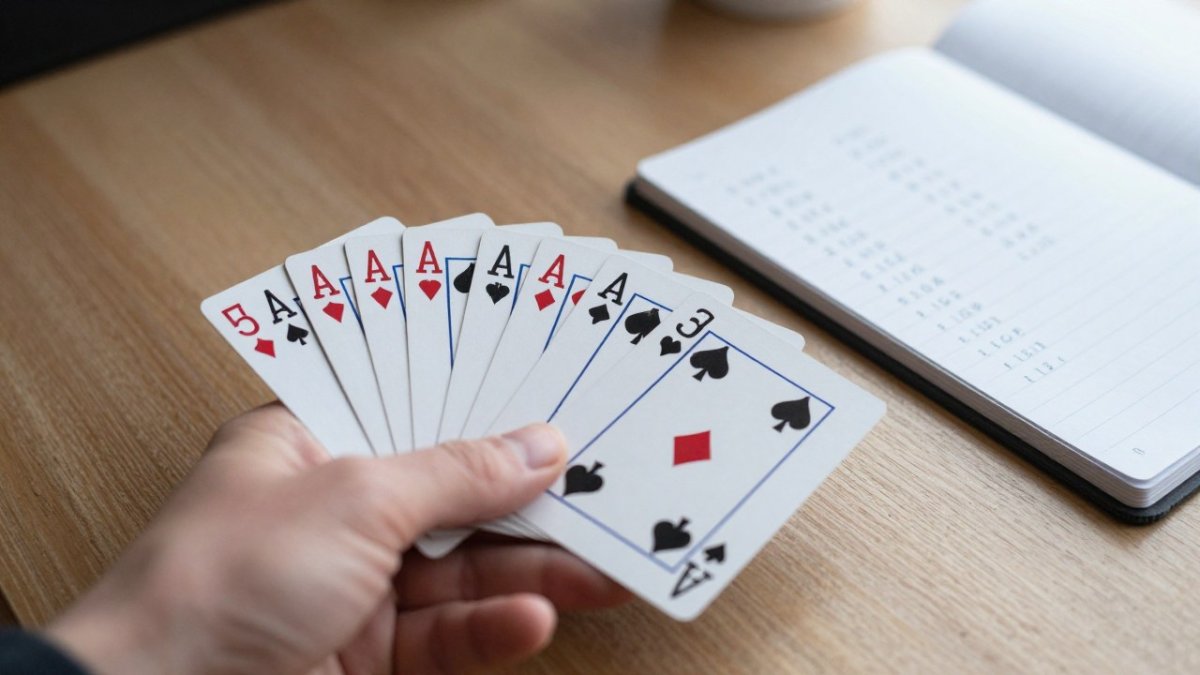
Scale comparisons help too. The number of atoms in the observable universe is commonly estimated at around 10^80, which is larger than 52! but the gap is smaller than intuition suggests. The number of possible deck orders is best understood as a count that dwarfs everyday quantities like grains of sand on a beach.
Probability of One Particular Shuffled Order
If a deck is shuffled perfectly at random, every one of the 52! orderings is equally likely. That means any single specified order, such as a deck sorted from ace of spades to king of hearts in a fixed sequence, has a probability of 1 in 52!. Written out, that is roughly 1 in 8.07 × 10^67.
This result depends on a specific assumption: that each ordering has the same chance of occurring. A perfect random shuffle produces that uniform outcome. Real shuffling methods, such as a few riffle shuffles done by hand, do not reach perfect randomness, so some orderings are slightly more likely than others. Researchers who study shuffling use the number of shuffles needed for the deck to be close to random as a measure of how well a method mixes the cards.
The result also separates two questions that people often blend together. The chance that one particular order appears is extremely small, yet the chance that some order appears is exactly 1, because every shuffle produces one of the 52! possibilities. A specific sequence being rare does not make the shuffle unusual; it just reflects how many sequences exist.
The gap between the two questions is the useful takeaway. The count of orderings tells you how many outcomes are possible. The probability tells you how likely one chosen outcome is. Keeping both in view avoids the common mistake of treating an astonishing-looking deck as evidence that something unusual happened.
Using the Number Confidently in Your Own Work
If you cite 52 factorial in a classroom, a blog, or a presentation, state the definition, give the scientific notation, and name the context. Say “the number of possible orderings of a standard 52-card deck” rather than vague claims of “more than atoms in the universe,” which can mislead depending on the comparison used.
For readers who want more precision, the key facts are these: 52! equals 52 × 51 × … × 1, it is about 8.0658175 × 10^67, and it counts permutations of a standard deck. Keep those three points in view and the number stays both accurate and memorable.
This is informational only, not emergency care, and not a substitute for medical advice.
Frequently Asked Questions
Why is 52 factorial so special?
52 factorial is special because it is the number of distinct orders a standard 52-card deck can be arranged in. Multiplying 52 × 51 × 50 and continuing down to 1 gives approximately 8.0658 × 10^67, a number far larger than the count of atoms on Earth. Its size makes it a useful reference point for explaining how quickly arrangements grow. Each card added to a list multiplies the total, which is why deck-order counts escape everyday intuition.
How large is 52 factorial?
52 factorial is approximately 8.0658 × 10^67, a number with 68 digits. Written out, it is an 8 followed by 67 more digits. For comparison, the estimated number of atoms in the observable universe is commonly put near 10^80, so 52 factorial is a small fraction of that. Scientific notation is the practical way to express it because the full digit string is hard to read or compare.
How many ways can you arrange a 52-card deck?
A standard 52-card deck can be arranged in 52! ways, which is about 8.07 × 10^67 distinct orders. This assumes every card is different, so each ordering counts separately. Reshuffling a deck produces an order that is, for practical purposes, unlikely to have occurred before in the history of card play. The count is a permutation count, meaning the order of the cards matters.
How long would it take to count to 52 factorial?
Counting to 52 factorial at one number per second would take roughly 2.5 × 10^60 years, far longer than the age of the universe. Even at a billion counts per second, the total would still exceed the age of the universe many times over. The time estimate shows that 52 factorial is not just large but practically uncountable by any human or machine process.
